Everyone has chosen to live here knowing that there is some aircraft noise because we are in the vicinity of Heathrow. But there are four significant risks that it will get a lot worse:
- A third runway – equivalent to a new Gatwick-sized airport
- Airspace Modernisation – new routes over our area
- Heathrow expansion using existing runways
- New takeoffs going overhead
1. THIRD RUNWAY – MASSIVELY MORE FLIGHTS
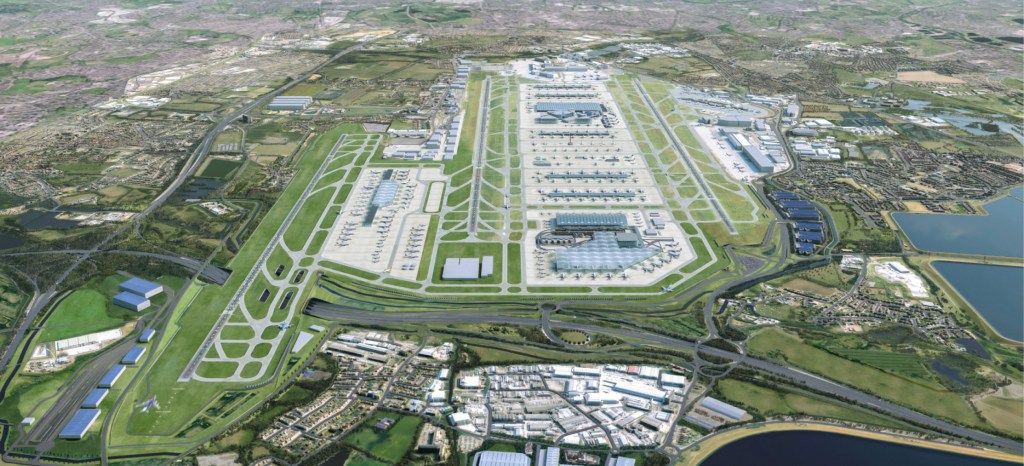
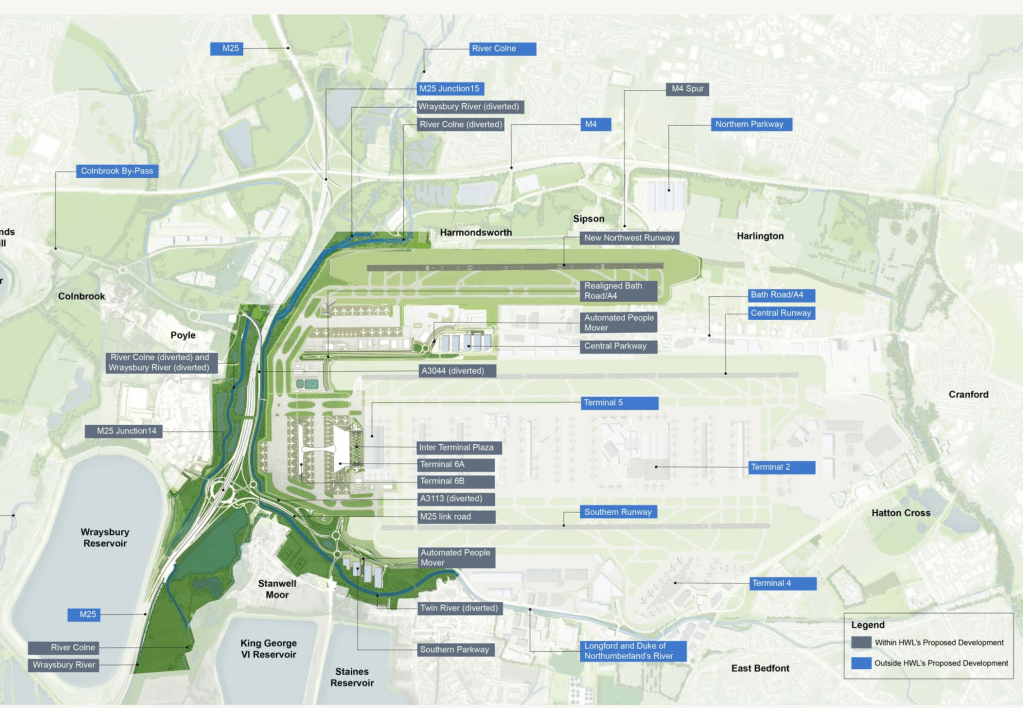
The Government says it wants a third runway at Heathrow in order to support economic growth (though the case is very weak). If it goes ahead, it will mean a 50% increase in flights – equivalent to a new airport the size of Gatwick. Of two formal 3rd runway proposals put forward, the one proposed by Heathrow Airport Ltd has been selected. (£49 billion, including £21 billion for the runway). It includes a full-length runway just to the north west of the existing airport area, with the M25 moved to go through a tunnel, adding massive cost and disruption. The estimated costs are eye-watering: £21 billion for the new runway, £12 billion for a new terminal complex, and £15 billion to modernise the existing facilities. Total £49 billion. The next step is for the Government to review and update the legal document, called the Airports National Policy Statement, against which they will consider the detailed proposals. Their (ambitious) aim is still for final planning permission to be given before the next election (mid 2029), and for a new runway to be in operation by 2035. But as you can see from this update for our supporters, there are a lot of uncertainties.
2. AIRSPACE MODERNISATION – NEW ROUTES OVER OUR AREA
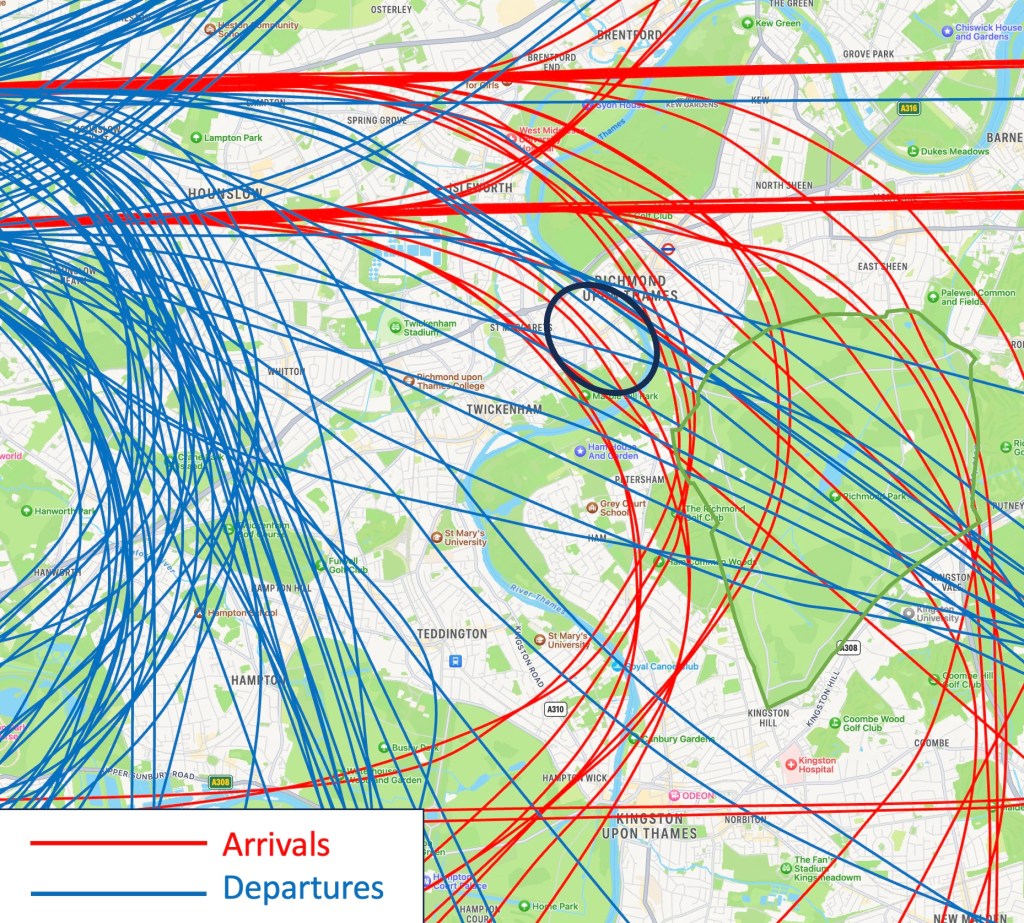
This national project will use new Performance Based Navigation technology (PBN) to upgrade, and potentially change, flight paths which have been in place for decades. Among options identified by Heathrow are new routes bringing aircraft over the centre of Richmond Park, Richmond Hill and East Twickenham. 60,000 arriving aircraft could be coming overhead each year. Right now we are close to some landing flight paths, but none come directly overhead. We – and Friends of Richmond Park – want a “do minimum” approach, where the flight paths stay largely as they are, given that everyone has chosen to live where they do with some knowledge of existing aircraft noise. Nothing has been decided on this yet. There will be public consultation, probably in 2027. So the aim is at least to ensure that a “do minimum” option is included in the consultation. But a new organisation (UK Airspace Design Service) is taking over responsibility for airspace design, and that could make it more difficult for local communities to have their voices heard when the consultation options are being selected, or when final decisions are being made and implemented, probably around 2030.
As well as new routes to enable the third runway, use of PBN technology on these new flight paths is expected to facilitate an expansion in the number of flights even without the new runway. And, because PBN enables much narrower flight paths, evidence from the US shows that anyone living directly underneath one will find themselves in a “noise sewer”.
This map shows some of the 140 flight path options being considered by Heathrow (East Twickenham is marked). Click here to see comparison between these and the current position. (Thanks to Friends of Richmond Park for these charts).
3. HEATHROW EXPANSION WITH EXISTING RUNWAYS – MORE FLIGHTS
Heathrow is currently capped at 480,000 flights a year (landing and takeoff) – a condition of planning permission for Terminal 5. But their – 98% overseas – owners are keen to grow. That means increasing the cap. The Government has already agreed expansions at London City, Stansted, Luton and Gatwick (subject to the airport meeting some reasonable conditions). Heathrow are pressing hard. Observers have suggested a 20% increase at Heathrow is on the cards. And it would be hard for the Government to refuse a request to expand by 20% using the existing two runways now that they have agreed in principle to the 50% expansion associated with the third runway. Heathrow may well achieve it by changing the way they use the runways to so-called ‘mixed mode’ – which would reduce or eliminate existing noise respite arrangements for people in local communities – or through more concentration using PBN technology and new routes, or more flights to fill quieter periods, or a combination. Either way, more flights mean a significant reduction in our quality of life.
4. EASTERLY ALTERNATION – NEW TAKE-OFFS OVERHEAD (IN ADDITION TO CURRENT LANDINGS)
From 2028 we are very likely to suffer a significant increase in noise from aircraft taking off from Heathrow’s northern runway. We can try to resist it, but the odds are stacked against us.
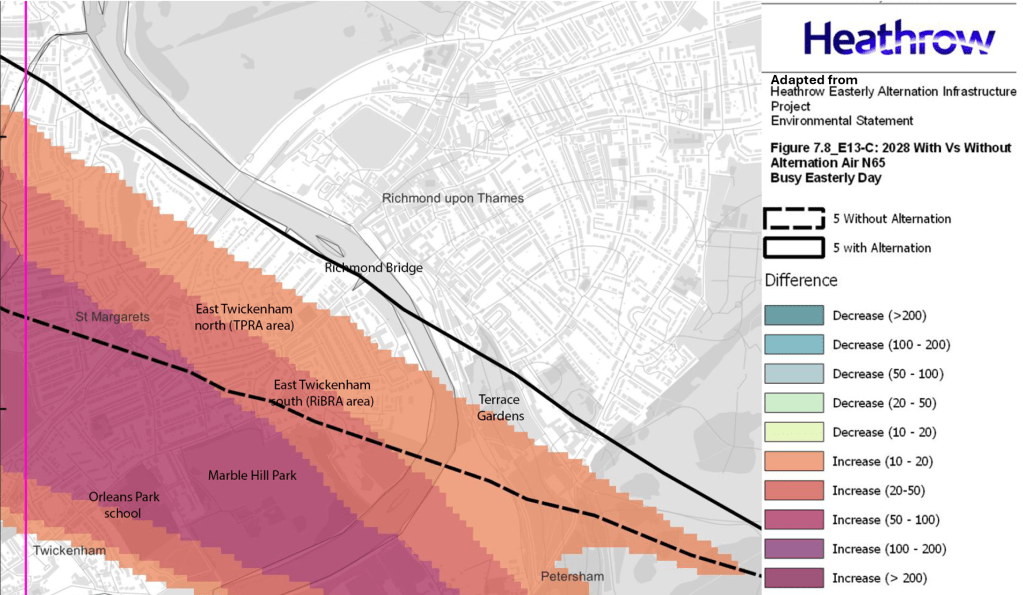
On days when it’s happening – around 30 percent of days on average are what’s called ‘easterly operations’ due to wind direction – we expect to experience noise levels of around 70 decibels (dB) when a plane is overhead, and up to 80db in a few cases – as loud as an alarm clock. That will happen many times a day during ‘easterly operations’, from early morning till late evening. We will normally get half a day’s respite. Planning permission for work on the ground to enable easterly takeoffs from the northern runway was to be decided by Hillingdon Council in February 2025, but the timing has slipped.
No new routes are required, but Heathrow will have to execute the Planned and Permanent Redistribution of Air Traffic (PPR) process to get permission to make regular use of currently-unused easterly departure routes from the northern runway. (This is all separate from airspace modernisation.)
Click here to understand:
– Why it’s happening
– Why it’s hard to stop
Noise Map showing number of events exceeding 65 decibels that we will experience on a “busy easterly day” (06:00 to 23:30) according to Heathrow’s modelling. That’s loud – in a few cases as loud as an alarm clock. There will be half-a-day respite as they alternate runways.
 East Twickenham Heathrow Campaign